The other day I harvested a big bucket of vegetables.
Included in the haul are:
yellow squash (Early Straightneck)
sweet red Italian peppers (Jimmy Nardello variety)
green beans (McCaslan)
purple beans (Louisiana purple pod)
Cherry tomatoes (Matt's Wild Cherry)
Friday, July 30, 2010
luna moth
I saw a luna moth at the kitchen door the other night. This wasn't the hugest one I've ever seen, but it was really cool looking. It kept banging itself against the door, and the only way I could make it stop was to turn off all the lights inside.
Another visit to Three Sisters Farm
The Cookeville Master Gardener's group made a field trip last week to Three Sisters Farm near Cookeville. The farm has a booth every Saturday at the Cookeville farmer's market. There really are three sisters who do the work of growing the vegetables, along with their mother.
Here is Ashley, welcoming the group to the farm:
The first thing I noticed was baby figs growing on a fig tree. I think Wendy said it was a Brown Turkey fig:
Nearby was a companion plant to figs, arugula. In Italy, figs are often served with arugula. The arugula had been under a low tunnel or hoop house, which you can see in the background.
The vegetable garden is laid out in neat wide rows with mowed paths.
Although it was pretty hot that evening, everybody enjoyed walking around and looking at all the food. We saw tomatoes, cucumbers, squash, pumpkins, okra, peppers, gourds, and these interesting long beans.
Long beans are in the same family with black-eyed peas, and they are easier to grow in hot weather than regular beans. Insects don't seem to bother them. Some of them are almost two feet long!
Another unusual vegetable we saw was this red okra:
The farm also grows and sells flowers. The sunflowers were particularly spectacular when we visited.
Some of us went down to the barn to see some new baby goats. They were very sweet and tame, and you could pick them up and cuddle them and kiss their lips, and they didn't mind at all, even though both were billies.
These two little billies are twins.
After the tour we had watermelon, and chips and salsa, and we sat in the shade and talked. Trevor told me about his deer hunting plans for fall, and he climbed up into a deer stand in the backyard.
Here is Ashley, welcoming the group to the farm:
The first thing I noticed was baby figs growing on a fig tree. I think Wendy said it was a Brown Turkey fig:
Nearby was a companion plant to figs, arugula. In Italy, figs are often served with arugula. The arugula had been under a low tunnel or hoop house, which you can see in the background.
The vegetable garden is laid out in neat wide rows with mowed paths.
Although it was pretty hot that evening, everybody enjoyed walking around and looking at all the food. We saw tomatoes, cucumbers, squash, pumpkins, okra, peppers, gourds, and these interesting long beans.
Long beans are in the same family with black-eyed peas, and they are easier to grow in hot weather than regular beans. Insects don't seem to bother them. Some of them are almost two feet long!
Another unusual vegetable we saw was this red okra:
The farm also grows and sells flowers. The sunflowers were particularly spectacular when we visited.
Some of us went down to the barn to see some new baby goats. They were very sweet and tame, and you could pick them up and cuddle them and kiss their lips, and they didn't mind at all, even though both were billies.
These two little billies are twins.
After the tour we had watermelon, and chips and salsa, and we sat in the shade and talked. Trevor told me about his deer hunting plans for fall, and he climbed up into a deer stand in the backyard.
Tuesday, July 13, 2010
Blueberry Ice Cream
Tom and I picked thirty pounds of blueberries yesterday, at Hidden Springs Orchard, near Cookeville, TN. That amounted to about 8 gallons or so. They were very beautiful and sweet.
I made jam this morning of course, using a pretty straightforward recipe: 9 cups of berries to five cups of sugar, cook to gelling point, ladle into jars, process 10 minutes.
Also this evening I made blueberry ice cream. OMG. The best ever. Just the color alone would be reason to make this, but it is also awesomely good.
I used this recipe from an old Gourmet, but I messed with it a little: I used creme fraiche for part of the cream. Creme fraiche is sort of like sour cream. I make it by warming cream to 86 degrees, then adding a little buttermilk (1/4 cup per quart of cream) and letting it sit on the counter overnight. It thickens and gets tart and is good in everything, savory or sweet.
Also, the recipe instructs you to strain the blueberry/sugar mixture after cooking it, but I didn't, and neither did most of the cooks who reviewed the recipe on the epicurious website. The ice cream has a little texture of blueberry seeds and skins, but that seems perfectly ok.
So go to Hidden Springs Orchard, pick your blueberries and go to it. You only need two cups of blueberries for this recipe, so you could just buy them at the Cookeville farmer's market on Saturday from Brinna.
I made jam this morning of course, using a pretty straightforward recipe: 9 cups of berries to five cups of sugar, cook to gelling point, ladle into jars, process 10 minutes.
Also this evening I made blueberry ice cream. OMG. The best ever. Just the color alone would be reason to make this, but it is also awesomely good.
I used this recipe from an old Gourmet, but I messed with it a little: I used creme fraiche for part of the cream. Creme fraiche is sort of like sour cream. I make it by warming cream to 86 degrees, then adding a little buttermilk (1/4 cup per quart of cream) and letting it sit on the counter overnight. It thickens and gets tart and is good in everything, savory or sweet.
Also, the recipe instructs you to strain the blueberry/sugar mixture after cooking it, but I didn't, and neither did most of the cooks who reviewed the recipe on the epicurious website. The ice cream has a little texture of blueberry seeds and skins, but that seems perfectly ok.
So go to Hidden Springs Orchard, pick your blueberries and go to it. You only need two cups of blueberries for this recipe, so you could just buy them at the Cookeville farmer's market on Saturday from Brinna.
Tuesday, June 15, 2010
Container Garden
After Three Sisters Farm, I visited a very different sort of garden: an urban garden in containers.
I first saw this garden a few years ago when the gardener had a party. She has expanded it with more containers and more flowers and herbs and vegetables. She adds a few new containers every year.
The containers sit on and beside an asphalt driveway.
A galvanized tub makes a great container for plants. Rather than drilling holes in the bottom, the gardener simply filled the bottom of the pot with shards of broken pots, to provide drainage.
These are tiny petunia-like flowers, but I'm not sure they are actually petunias.
One downside to container gardening is the fact that you have to water a lot. But sedums like dry soil, so they're a good choice for containers with a sharp, well-drained soil mix.
Cute containers are one of the fun parts of container gardening:
Some people use old shoes, olive oil cans, plastic buckets, and wheelbarrows as planters.
Also you can make your own containers with hypertufa, a mix of concrete, perlite, and peat moss.
Some people like self-watering containers. The Mother Earth News had an article about how to make them. You can also buy self-watering containers, for a bit more than it would cost to make them.
There are also water-retaining gels, or crystals, that you can mix with potting soil. When you water, the gel swells up and then slowly releases water to the plant. The pros and cons of this stuff are discussed in this article.
This gardener also has a water tank that collects water from her roof to water the garden with:
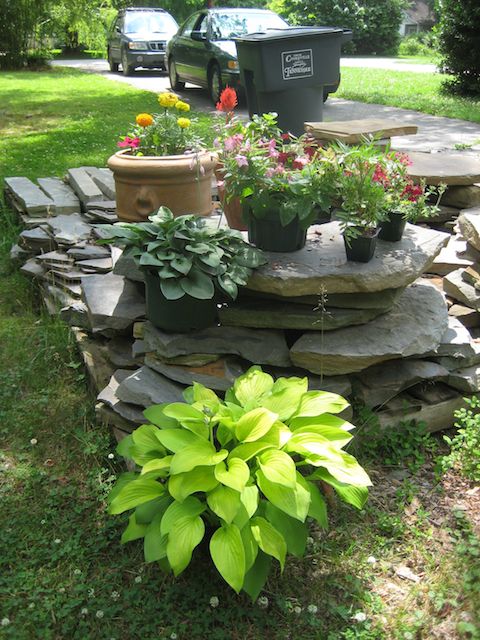
One of the most aesthetically pleasing things about this container garden is that some of the containers are on the ground, but some are propped up at a different level, on a chair or on rocks. This makes the garden seem more three dimensional than a garden that's planted in the ground. I mean, all gardens exist in three dimensions, but a regular garden in the ground is planted mostly on one plane. With containers, there can be multiple planes, almost like terraces.
A neighbor gave the gardener these beautiful stones, and she is planning to lay out a terrace and some walls with them.
She said it was surprising how well the hostas have done in her containers. Mostly we think of planting annuals in containers, but a lot of perennials like them too. There was a huge rosemary plant spilling out of one pot, for example.
You can think of a container garden as a collection of really small raised beds. The plants are easier to reach; the soil is loose and easy to weed; and each pot can have a mix in it that is specifically tailored to that plant's requirements. Plants can be moved around fairly easily to make the most pleasing arrangement. Makes you wonder why we work so hard to plant things in the ground!
I first saw this garden a few years ago when the gardener had a party. She has expanded it with more containers and more flowers and herbs and vegetables. She adds a few new containers every year.
The containers sit on and beside an asphalt driveway.
A galvanized tub makes a great container for plants. Rather than drilling holes in the bottom, the gardener simply filled the bottom of the pot with shards of broken pots, to provide drainage.
These are tiny petunia-like flowers, but I'm not sure they are actually petunias.
One downside to container gardening is the fact that you have to water a lot. But sedums like dry soil, so they're a good choice for containers with a sharp, well-drained soil mix.
Cute containers are one of the fun parts of container gardening:
Some people use old shoes, olive oil cans, plastic buckets, and wheelbarrows as planters.
Also you can make your own containers with hypertufa, a mix of concrete, perlite, and peat moss.
Some people like self-watering containers. The Mother Earth News had an article about how to make them. You can also buy self-watering containers, for a bit more than it would cost to make them.
There are also water-retaining gels, or crystals, that you can mix with potting soil. When you water, the gel swells up and then slowly releases water to the plant. The pros and cons of this stuff are discussed in this article.
This gardener also has a water tank that collects water from her roof to water the garden with:
One of the most aesthetically pleasing things about this container garden is that some of the containers are on the ground, but some are propped up at a different level, on a chair or on rocks. This makes the garden seem more three dimensional than a garden that's planted in the ground. I mean, all gardens exist in three dimensions, but a regular garden in the ground is planted mostly on one plane. With containers, there can be multiple planes, almost like terraces.
A neighbor gave the gardener these beautiful stones, and she is planning to lay out a terrace and some walls with them.
She said it was surprising how well the hostas have done in her containers. Mostly we think of planting annuals in containers, but a lot of perennials like them too. There was a huge rosemary plant spilling out of one pot, for example.
You can think of a container garden as a collection of really small raised beds. The plants are easier to reach; the soil is loose and easy to weed; and each pot can have a mix in it that is specifically tailored to that plant's requirements. Plants can be moved around fairly easily to make the most pleasing arrangement. Makes you wonder why we work so hard to plant things in the ground!
Three Sisters Farm
I met some farmers at the farmer's market in Cookeville, and I liked their produce so much that I went to visit their farm. It's called Three Sisters Farm, because three sisters and their mother are the farmers.
It's a beautiful small farm outside Cookeville. There are extensive vegetable gardens, beautiful flowers (mostly perennials but also some annuals), hay fields, some berry bush plantings, and best of all: goats!
This is a young Nubian goat. A very friendly youngster.
Nubians have long, pendulous ears, rather like Brahma cattle. More specifically, these goats are Anglo-Nubian goats, a breed that is a cross between an English dairy goat and a Middle Eastern breed. Their milk has a high butterfat content.
Above is one of the nannies, or does. And below is a billy, or buck.
Three Sisters Farm also has chickens. The cutest one is a banty rooster.
He's tamer than any rooster I've ever handled. He will let you pick him up and pet him. None of my roosters were ever that gentle! Some of them fought me every time I went in the chicken pen. This banty is not a fighting cock, as far as I could tell. Good thing he lives on a peaceful farm.
The three sisters like to grow guords. That was one of my earliest horticultural passions also. A friend burned a picture of a goat onto one of their birdhouse guords:
It's a beautiful small farm outside Cookeville. There are extensive vegetable gardens, beautiful flowers (mostly perennials but also some annuals), hay fields, some berry bush plantings, and best of all: goats!
This is a young Nubian goat. A very friendly youngster.
Nubians have long, pendulous ears, rather like Brahma cattle. More specifically, these goats are Anglo-Nubian goats, a breed that is a cross between an English dairy goat and a Middle Eastern breed. Their milk has a high butterfat content.
Above is one of the nannies, or does. And below is a billy, or buck.
Three Sisters Farm also has chickens. The cutest one is a banty rooster.
He's tamer than any rooster I've ever handled. He will let you pick him up and pet him. None of my roosters were ever that gentle! Some of them fought me every time I went in the chicken pen. This banty is not a fighting cock, as far as I could tell. Good thing he lives on a peaceful farm.
The three sisters like to grow guords. That was one of my earliest horticultural passions also. A friend burned a picture of a goat onto one of their birdhouse guords:
Saturday, May 15, 2010
Garden Growing Wild
In Christopher Alexander's book, A Pattern Language, he extols the beauty of the wild garden:
"A garden which grows true to its own laws is not a wilderness, yet not entirely artificial either....In the garden growing wild, the plants are chosen, and the boundaries placed, in such a way that the growth of things regulates itself. It does not need to be regulated by control. But it does not grow fiercely and undermine the ways in which it is planted. Natural wild plants, for example, are planted among flowers and grass, so that there is no room for so-called weeds to fill the empty spaces and then need weeding....A garden growing wild is healthier....The garden can be left alone, it will not go to ruin in one or two seasons...the gardens that have to be tended obsessively enslave a person to them....Therefore, grow grasses, mosses, bushes, flowers and trees in a way which comes close to the way that they occur in nature: intermingled, without barriers between them, without bare earth, without formal flower beds."
I have been trying to achieve this for a long time, and I think I finally let it happen this year.
The garden is an amazing jumble of blooming color.
How did it happen? In the past I had the jumble of plants all right, but there were a lot more weeds and fewer blooms. I changed a couple of things, and I think those changes made a big difference.
First, I had some trees to the uphill east of the garden taken down, so that more sunlight reaches it. That helped the irises, peonies, and roses bloom more.
Second, I filled all the beds as closely as possible with perennials. In the past some of the four or five beds were half empty, and weeds did grow in those spaces. I didn't buy many new perennials; I just divided the ones I already had, mostly daylilies, peonies, and bearded iris and Siberian irises. I used to think you had to have a lot of different kinds of flowers in a "good" perennial garden, but now I know that you can just keep dividing the ones you have, and the effect will be really lush. I also found out that it's better if you use a closer spacing than what the directions say: instead of fifteen inches apart for daylilies, for example, put them twelve inches apart.
Third, I have a couple of biennial and annual species that seed themselves, sometimes prolifically: Dame's Rocket, nigella, a few corn poppies, columbines, and hollyhocks, plus some ones whose names I'vc forgotten. I sometimes help these seed themselves by shaking the seedpods around the place when they go to seed. The birds plant the poppies I think, because they crop up in surprising places like the vegetable garden.
I used to try to make foxgloves grow, but it's too much trouble: they don't really seed themselves. These self-seeding biennials and annuals fill in the spaces between the perennials. To help them, I don't use a lot of mulch; that would prevent the seeds from reaching the soil.
Finally, I actually started fertilizing my garden with alfalfa pellets mainly. The main missing nutrient was nitrogen, and alfalfa is an organic nitrogen source. I sprinkled it around the garden last summer and again in March. The roses in particular have done a lot better since I started fertilizing them. I have two David Austen roses, Heritage and Gertrude Jekyll, plus some wilder ones that I found around Putnam County and rooted.
(In the past I've used regular chemical fertilizer, but it seemed to encourage to much rank weed growth.)
Also I've learned not to be afraid to try to divide pretty much anything. I started out with two peony bushes, and now I have many. It takes a couple of years for a new division to make flowers, but it's worth it. And it's the best way to get the many plants you need for that full, lush, wild garden effect.
The wild garden style suits my situation since I am not at my garden for months at a time. I spend most of my gardening time growing vegetables to eat, but I love to look at, photograph, draw, and give away flowers. So the fact that I spent almost no time at all on this garden, and yet it looks so beautiful, seems wonderful to me, like a gift. I think I would do it this way even if I were here all the time.
"A garden which grows true to its own laws is not a wilderness, yet not entirely artificial either....In the garden growing wild, the plants are chosen, and the boundaries placed, in such a way that the growth of things regulates itself. It does not need to be regulated by control. But it does not grow fiercely and undermine the ways in which it is planted. Natural wild plants, for example, are planted among flowers and grass, so that there is no room for so-called weeds to fill the empty spaces and then need weeding....A garden growing wild is healthier....The garden can be left alone, it will not go to ruin in one or two seasons...the gardens that have to be tended obsessively enslave a person to them....Therefore, grow grasses, mosses, bushes, flowers and trees in a way which comes close to the way that they occur in nature: intermingled, without barriers between them, without bare earth, without formal flower beds."
I have been trying to achieve this for a long time, and I think I finally let it happen this year.
The garden is an amazing jumble of blooming color.
How did it happen? In the past I had the jumble of plants all right, but there were a lot more weeds and fewer blooms. I changed a couple of things, and I think those changes made a big difference.
First, I had some trees to the uphill east of the garden taken down, so that more sunlight reaches it. That helped the irises, peonies, and roses bloom more.
Second, I filled all the beds as closely as possible with perennials. In the past some of the four or five beds were half empty, and weeds did grow in those spaces. I didn't buy many new perennials; I just divided the ones I already had, mostly daylilies, peonies, and bearded iris and Siberian irises. I used to think you had to have a lot of different kinds of flowers in a "good" perennial garden, but now I know that you can just keep dividing the ones you have, and the effect will be really lush. I also found out that it's better if you use a closer spacing than what the directions say: instead of fifteen inches apart for daylilies, for example, put them twelve inches apart.
Third, I have a couple of biennial and annual species that seed themselves, sometimes prolifically: Dame's Rocket, nigella, a few corn poppies, columbines, and hollyhocks, plus some ones whose names I'vc forgotten. I sometimes help these seed themselves by shaking the seedpods around the place when they go to seed. The birds plant the poppies I think, because they crop up in surprising places like the vegetable garden.
I used to try to make foxgloves grow, but it's too much trouble: they don't really seed themselves. These self-seeding biennials and annuals fill in the spaces between the perennials. To help them, I don't use a lot of mulch; that would prevent the seeds from reaching the soil.
Finally, I actually started fertilizing my garden with alfalfa pellets mainly. The main missing nutrient was nitrogen, and alfalfa is an organic nitrogen source. I sprinkled it around the garden last summer and again in March. The roses in particular have done a lot better since I started fertilizing them. I have two David Austen roses, Heritage and Gertrude Jekyll, plus some wilder ones that I found around Putnam County and rooted.
(In the past I've used regular chemical fertilizer, but it seemed to encourage to much rank weed growth.)
Also I've learned not to be afraid to try to divide pretty much anything. I started out with two peony bushes, and now I have many. It takes a couple of years for a new division to make flowers, but it's worth it. And it's the best way to get the many plants you need for that full, lush, wild garden effect.
The wild garden style suits my situation since I am not at my garden for months at a time. I spend most of my gardening time growing vegetables to eat, but I love to look at, photograph, draw, and give away flowers. So the fact that I spent almost no time at all on this garden, and yet it looks so beautiful, seems wonderful to me, like a gift. I think I would do it this way even if I were here all the time.
Subscribe to:
Posts (Atom)